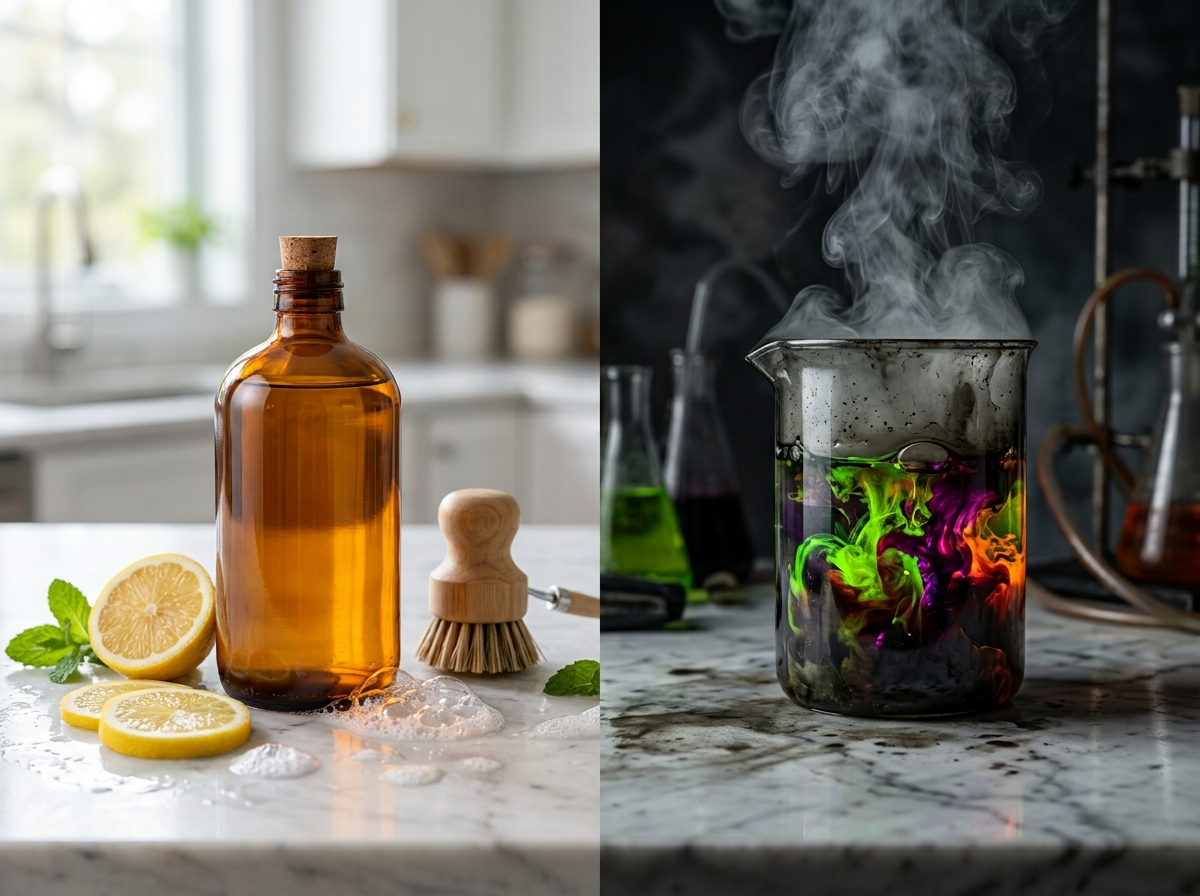
A bottle can look green, say “plant-powered,” and still leave you wondering what, exactly, makes it eco-friendly. Dish soap is a surprisingly important example because every squeeze eventually becomes wastewater, while the bottle, fragrance, ingredients, and manufacturing choices all leave a different environmental footprint.
The useful answer is not simply “choose a natural soap.” Natural is not a precise environmental standard, and plant-derived does not automatically mean harmless. A better approach is to evaluate the whole product: how its cleaning ingredients behave in water, how readily they biodegrade, what hazards they present, how much packaging is used, whether the formula is transparent, and whether the soap actually performs well enough to avoid waste.
This guide breaks down those factors so you can judge an eco-friendly dish soap without relying on a leaf-shaped label or vague green marketing. Learning how green marketing vs greenwashing works helps you judge those claims. It also explains why certifications matter, what “biodegradable” really tells you, and where a product such as Seventh Generation dish soap fits into the larger picture.
What Does Eco-Friendly Dish Soap Actually Mean?
Eco-friendly dish soap is best understood as a product designed to reduce environmental impact across several stages of its life rather than as a product with one special ingredient. The strongest options balance cleaning performance with safer chemistry, responsible sourcing, efficient packaging, and appropriate disposal.
Start with the formula. Surfactants are the workhorses of dish soap: they help water spread, loosen food soils, surround grease, and carry residue away during rinsing. The environmental profile of a surfactant depends on factors such as aquatic toxicity, biodegradation rate, and what it becomes as it breaks down. The U.S. Environmental Protection Agency’s Safer Choice program evaluates these characteristics rather than assuming that “plant-based” automatically equals safer.
Packaging is the second major piece. A highly biodegradable formula sold in an oversized, single-use bottle is not the same sustainability proposition as a concentrated formula in recycled or refillable packaging. The right question is therefore not “Is this bottle recyclable?” but “How much material was needed to deliver the amount of cleaning power I actually use?” For a wider look at materials, see these eco-friendly packaging solutions.
Finally, performance matters. A soap that needs three times as much product, hot water, or repeated scrubbing to clean the same load can undermine some of its environmental advantages. A genuinely useful eco-friendly product should work effectively when used as directed.
1. Look at the Surfactants, Not Just the Front Label
Surfactants deserve more attention than marketing language because they perform the core cleaning function. Common surfactant families include glucosides, betaines, amine oxides, and sulfate-based surfactants. Their names alone do not provide a complete environmental verdict.
For example, a surfactant can be plant-derived and still have a chemistry that requires careful evaluation. Conversely, “synthetic” does not automatically mean environmentally harmful. EPA’s Safer Choice framework evaluates chemicals within their functional class, considering properties such as aquatic toxicity and environmental fate. That is a much more useful standard than dividing ingredients into “natural” and “chemical.”
When comparing products, look for a complete ingredient list and, where available, credible certification. A transparent manufacturer should make it reasonably easy to understand what performs the cleaning, what controls pH, what preserves the formula, and what provides fragrance.
This is also why a Seventh Generation dish soap formula can be more nuanced than a simple “natural versus synthetic” comparison. Seventh Generation’s current dish liquids list ingredients such as plant-derived sodium lauryl sulfate, lauramine oxide, and decyl glucoside, alongside preservatives and processing aids. The product also carries EPA Safer Choice certification on the cited formulations. The lesson is not that every ingredient is automatically perfect; it is that responsible evaluation requires looking at the entire formula and the certification behind the finished product.
2. Biodegradability Matters—but It Is Not the Whole Story
“Biodegradable” sounds like the finish line, but it is only one part of the environmental assessment. Ready biodegradability generally refers to a substance breaking down relatively quickly under defined aquatic conditions. EPA also considers aquatic toxicity and degradation products when evaluating safer surfactants.
That distinction matters because a substance can degrade and still raise concerns during the period before degradation, or it may break down into products that deserve scrutiny. A stronger eco-friendly dish soap therefore combines good biodegradation characteristics with low concern for aquatic life.
Look for specific, verifiable language instead of relying on broad claims. A company that provides certification details, ingredient information, or testing standards gives you more evidence than one that simply prints “green” on the label.
The same principle applies to septic use. A dish soap can be biodegradable and still need to be used according to its label and your septic system guidance. Eco-friendly chemistry is about reducing avoidable environmental burdens, not creating a license to pour large quantities down the drain.
3. Packaging Can Make or Break the Sustainability Equation
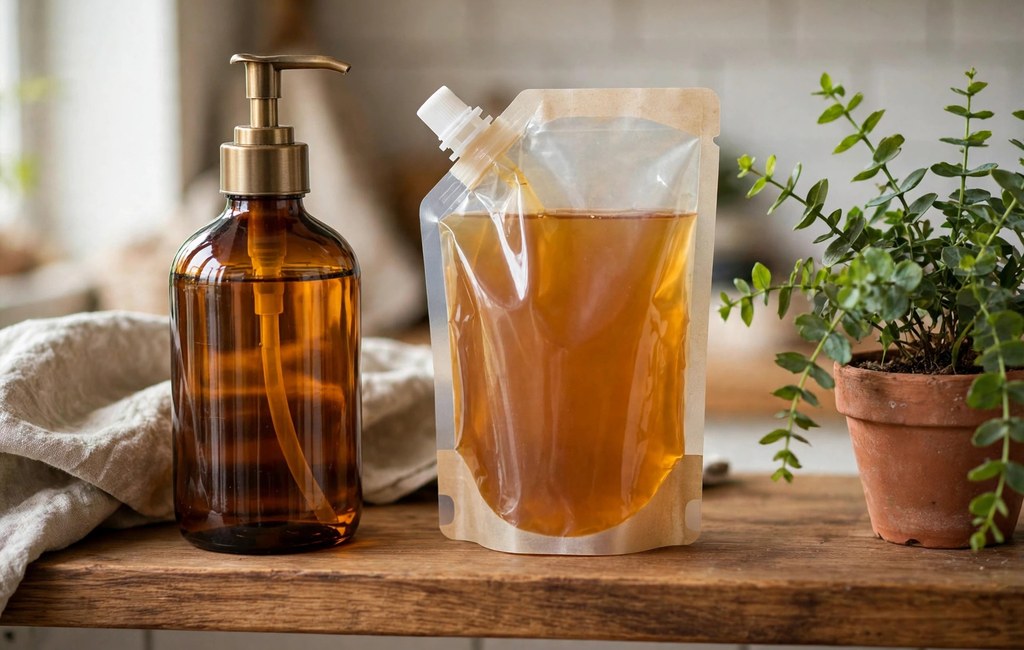
Dish soap is mostly water, so shipping a dilute liquid in a new bottle has an obvious material and logistics cost. That makes concentration and packaging unusually important when comparing eco-friendly products.
Useful packaging features include recycled plastic content, refill systems, durable dispensers, concentrated formulas, and packaging that is genuinely accepted by your local recycling program. A related option is zero-waste dish soap, which skips the plastic bottle entirely. A refill pouch can reduce material in some situations, but it should not be assumed to be better everywhere; the actual material, transportation, reuse pattern, and local recycling infrastructure all matter.
Concentration also changes the equation. If a small amount of soap cleans a full sink, the bottle can last longer and fewer containers may be required over time. But concentrated products should still be used according to directions. “More concentrated” is valuable only if consumers do not compensate by over-pouring.
When you plan broader sustainability choices—such as eco-friendly party ideas—the same principle applies: evaluate the entire system rather than one attractive feature. Reusable servingware, sensible quantities, local sourcing, and low-waste cleanup can matter more than a single “green” item. The same whole-system thinking works in the kitchen.
4. Fragrance and Preservatives Deserve a Closer Look
Fragrance is one area where shoppers can easily confuse “natural” with “risk-free.” Essential oils and botanical extracts are still chemical mixtures, and some fragrance materials can cause sensitization in susceptible people. EPA’s Safer Choice fragrance criteria screen for certain classes of concern and require disclosure of dermal sensitizers in certified products.
If fragrance is not important to you, fragrance-free can simplify the choice. It is also useful to understand the difference between “fragrance-free” and “unscented.” A product described as unscented may still use masking ingredients, while EPA’s fragrance-free designation has a specific meaning.
Preservatives are another example of why ingredient-by-ingredient fear lists can mislead. Liquid dish soap contains water and needs protection against microbial growth. Removing every preservative is not automatically a better formulation. The better question is whether the preservative system is appropriately selected, present at a justified level, disclosed clearly, and evaluated within a credible safety framework.
For households with sensitive skin, the practical test is equally important: choose a formula that you tolerate well, use gloves if recommended or helpful, and rinse dishes thoroughly.
5. Certifications Are More Useful Than Vague Green Claims
Third-party or government-backed certification can make comparison easier because it moves the discussion from advertising language to defined criteria. EPA Safer Choice is especially useful for household cleaners because the program evaluates ingredients and the finished product, and certified products must also meet performance requirements.
That last point is important. “Eco-friendly” should not mean “cleaning power sacrificed.” EPA says Safer Choice-labeled products must perform comparably to conventional products. The program also considers packaging and other environmental criteria.
Other labels can answer different questions. A biobased certification may tell you about renewable biological content. A cruelty-free certification addresses animal testing. A recycling symbol may describe the material, but not whether your local program accepts it. No single logo answers every sustainability question.
A good buying checklist therefore looks like this: transparent ingredients, credible environmental and safety criteria, effective cleaning, reasonable packaging, and instructions that match your household’s needs. This guide to eco-friendly cleaning products applies the same checklist to the whole category. The more claims a brand makes, the more valuable it is to ask what evidence supports each one.
6. What About “Natural” and “Plant-Based” Dish Soap?
Natural, plant-based, green, clean, and non-toxic are often used together in marketing, but they do not mean the same thing. EPA specifically notes that it is impossible to decide whether a product is safer simply because it is marketed as natural; you need to know the ingredients and understand their potential effects.
Plant-based is usually a sourcing description. It can be useful because renewable feedstocks may replace some petroleum-derived materials, but the origin of an ingredient does not determine its complete environmental profile. Manufacturing, purification, transportation, formulation, toxicity, biodegradation, and disposal all matter.
“Non-toxic” is even more important to treat cautiously. Toxicity depends on the substance, dose, route of exposure, and organism. A responsible product comparison should avoid absolute claims when the evidence is more nuanced.
In practice, choose evidence over adjectives. A transparent ingredient list and a credible certification are more informative than a bottle covered with leaves.
7. A Simple Shopping Checklist for Eco-Friendly Dish Soap
If you want a fast way to compare products, use this seven-point checklist:
- Cleaning agents: Identify the primary surfactants and look for credible safety and environmental information.
- Biodegradability: Prefer products with specific, verifiable biodegradation information rather than a generic green claim.
- Aquatic impact: Consider whether the formula has been evaluated for aquatic toxicity and environmental fate.
- Fragrance: If you do not need scent, a fragrance-free option can simplify ingredient exposure and may suit sensitive households.
- Packaging: Compare recycled content, refillability, concentration, durability, and local recyclability.
- Certification: Look for meaningful certification such as EPA Safer Choice when available.
- Performance: Confirm that it removes grease and food residue effectively at the recommended dose.
This framework is more reliable than choosing the product with the most sustainability buzzwords.
FAQs About Eco-Friendly Dish Soap
Is plant-based dish soap automatically eco-friendly?
No. Plant-based describes the origin of some ingredients, not the full environmental impact of the finished product. Check biodegradability, aquatic toxicity, packaging, transparency, and performance too.
Is biodegradable dish soap better for the environment?
It can be, but biodegradability is only one factor. The speed and pathway of degradation, aquatic toxicity, formulation, packaging, and use all matter.
Is Seventh Generation dish soap eco-friendly?
Several Seventh Generation dish liquid formulations carry EPA Safer Choice certification and make biobased and packaging claims. The specific formulation matters, so check the current ingredient list and product page rather than assuming every version is identical.
Does eco-friendly dish soap actually clean well?
It can. Effective dish soap still needs surfactants capable of loosening and emulsifying food soils. Credible certifications such as EPA Safer Choice include performance requirements.
Is fragrance-free better than scented dish soap?
Not universally, but fragrance-free can be a sensible preference for people who want to minimize fragrance ingredients or who are sensitive to them. EPA offers a specific fragrance-free designation for qualifying Safer Choice products.
Can eco-friendly dish soap be used with a septic system?
Many dish liquids are marketed as septic-compatible, but “eco-friendly” alone is not a septic certification. Use the product according to its label and follow your septic professional or local guidance, especially if your system has special requirements.
Conclusion: Choose the Whole Product, Not the Greenest Label
The most eco-friendly dish soap is not necessarily the one with the most natural-sounding name. It is the product that makes a defensible balance between safer chemistry, biodegradability, aquatic impact, responsible packaging, transparent labeling, and strong cleaning performance.
That is good news for shoppers because it gives you a repeatable method. Read the ingredient list. Look for credible certification. Compare packaging and concentration. Treat “natural” and “plant-based” as clues rather than proof. And judge performance honestly: a sustainable product still has to do the job.
If you are ready to make a practical switch, start with one product you use every day. Compare its formula, certification, packaging, and performance against two alternatives, then choose the option that reduces waste without creating new problems. Small decisions repeated every day can add up to a much more sustainable kitchen.